The abstract keyword is a non-access modifier, used for classes and methods: Abstract class: is a restricted class that cannot be used to create objects (to access it, it must be inherited from another class). Abstract method: can only be used in an abstract class, and it does not have a body.
Abstraction is a process of hiding the implementation details and showing only functionality to the user.
Another way, it shows only essential things to the user and hides the internal details, for example, sending SMS where you type the text and send the message. You don’t know the internal processing about the message delivery.
There are two ways to achieve abstraction in java
- Abstract class (0 to 100%)
- Interface (100%)
Abstract class in Java
A class which is declared as abstract is known as an abstract class. It can have abstract and non-abstract methods. It needs to be extended and its method implemented. It cannot be instantiated.
Points to Remember
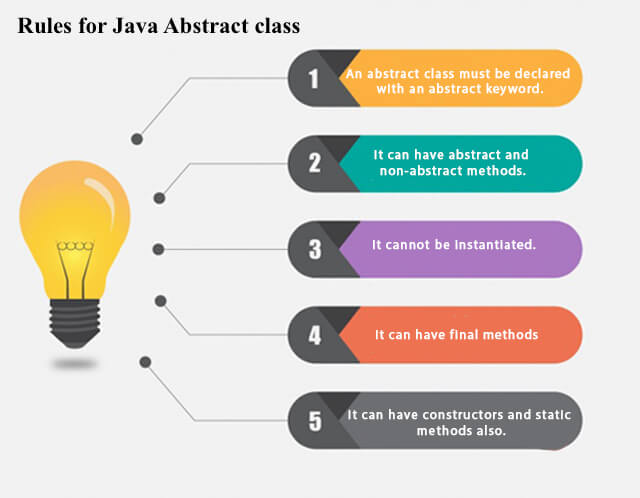
- An abstract class must be declared with an abstract keyword.
- It can have abstract and non-abstract methods.
- It cannot be instantiated.
- It can have constructors and static methods also.
- It can have final methods which will force the subclass not to change the body of the method.
Abstract Method in Java
A method which is declared as abstract and does not have implementation is known as an abstract method.
abstract void printStatus();//no method body and abstract References:
javapoint.com
w3schools.com

