Java Constructors
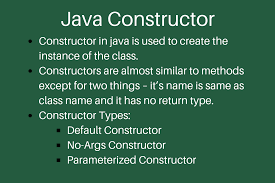
A constructor in Java is a special method that is used to initialize objects. The constructor is called when an object of a class is created. It can be used to set initial values for object attributes.
Note that the constructor name must match the class name, and it cannot have a return type (like void).
Also note that the constructor is called when the object is created.
All classes have constructors by default: if you do not create a class constructor yourself, Java creates one for you. However, then you are not able to set initial values for object attributes.
Constructor Parameters
Constructors can also take parameters, which is used to initialize attributes.
The following example adds an int y parameter to the constructor. Inside the constructor we set x to y (x=y). When we call the constructor, we pass a parameter to the constructor (5), which will set the value of x to 5:
Java Default Constructor
A constructor is called “Default Constructor” when it doesn’t have any parameter.
Syntax of default constructor:
- <class_name>(){}
Constructor Overloading in Java
In Java, a constructor is just like a method but without return type. It can also be overloaded like Java methods.
Constructor overloading in Java is a technique of having more than one constructor with different parameter lists. They are arranged in a way that each constructor performs a different task. They are differentiated by the compiler by the number of parameters in the list and their types.
References:-
- w3schools.com
- javapoint.com

